

 Argentina
 Australia
 Brazil
 Chile
Chile
 China
China
 Europe
 France
 Germany
 Hungary
 Italy
Italy
 Portugal
 South Africa
 Spain
Spain
 United Kingdom
 USA
USA
 Other countries

Studio in collaborazione con
l’Università degli Studi di Modena e Reggio Emilia

IRC7 AND VOLATILE THIOLS IN BEER
Genetic and functional diversity of IRC7 in brewing strains and its implications for aroma profile development
Understanding why genetically similar ale yeast strains can produce markedly different thiol-driven aroma profiles remains a key challenge in brewing science.
A study conducted at the University of Modena and Reggio Emilia and supported by AEB S.p.A. within the National Recovery and Resilience Plan (NRRP), analyzed 15 Saccharomyces cerevisiae ale brewing strains to investigate the genotype–phenotype relationship underlying thiol release during beer fermentation.
Published in the Journal of Food Biochemistry (Nasuti et al., 2026), the study links IRC7 genetic diversity to differences in β-lyase activity, the enzyme responsible for releasing aroma-active volatile thiols from hop- and malt-derived precursors, offering new insight into this variability.
Genotypic analyses
The presence of the IRC7 gene, responsible for β-lyase production, was verified, and its allelic form (long or short) was determined. In addition, potential genetic mutations that could reduce or abolish enzyme functionality were investigated.
To achieve this, Sanger sequencing was used, a precise and well-established laboratory technique that enables the reading of the DNA sequence. From this sequence, it’s then possible to reconstruct the encoded protein and assess its functional capability.
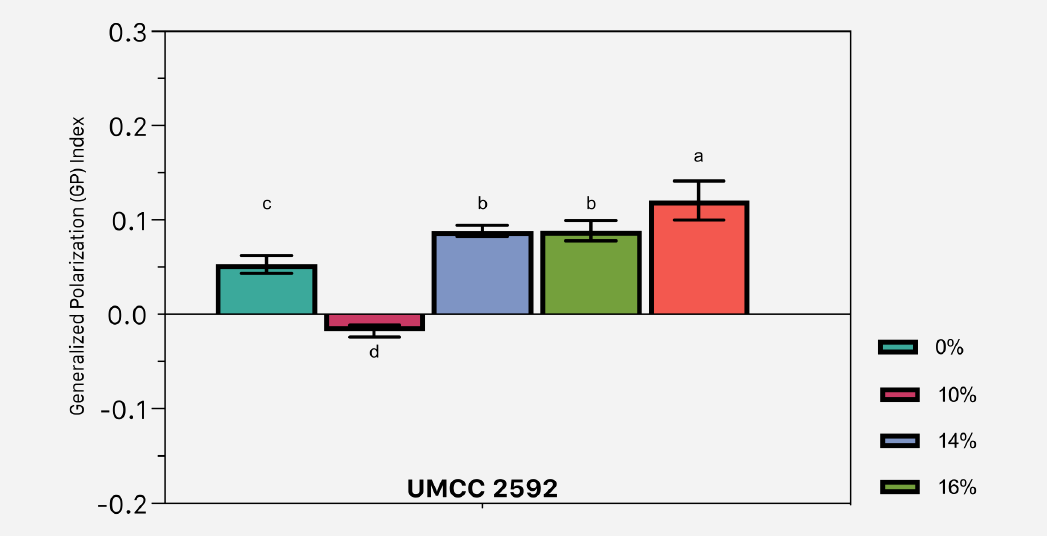
Figura 1
Valori di fluidità di membrana, indicati come indice GP, del ceppo S. cerevisiae UMCC 2592 alle diverse condizioni di stress da etanolo (0, 10, 14, 16 e 18% v/v). Lettere diverse indicano differenze significative (p<0,05).
Phenotypic analyses
An indirect enzymatic assay was performed to evaluate the actual activity of β-lyase. In this assay, the initial compound is transformed by β-lyase and, through a secondary reaction, a measurable change over time is generated. This change is detected by spectrophotometry, by monitoring absorbance variation at a specific wavelength. The greater the change in absorbance, the higher the enzymatic activity.
This “in vitro” assay simulates what occurs during fermentation. And allows a reliable estimation of how effectively a yeast strain can release fruity and tropical aromas from initially non-aromatic compounds.
Conclusions
The results show that most Saccharomyces cerevisiae ale brewing strains possess the functional form of the gene (IRC7L). However, the presence of this allele alone does not fully explain the observed enzymatic activity or the resulting aromatic profile. The results highlight the complexity of the relationship between genotype and phenotype, showing that genetic characteristics, gene expression, enzyme activity and substrate availability can all contribute to the final aromatic outcome. In particular, the alleles and the substrate on which the enzyme acts are key factors in determining aroma intensity.
| YEAST | Beta-lyase activity |
|---|---|
| FERMOALE BEL-ABBEY | HIGH |
| FERMOALE | HIGH |
| FERMOALE WEISS | HIGH |
| FERMOALE AY4 | HIGH |
| FERMOALE GERMAN K | MEDIUM |
| FERMOALE NEW-E | MEDIUM |
| FERMOALE AY3 | MEDIUM |
| FERMO KVEIK SV | MEDIUM |
How to read the table: while β-lyase activity alone does not fully determine the final aromatic profile, the classification below provides a useful reference for comparing the thiol-release potential of different brewing strains.